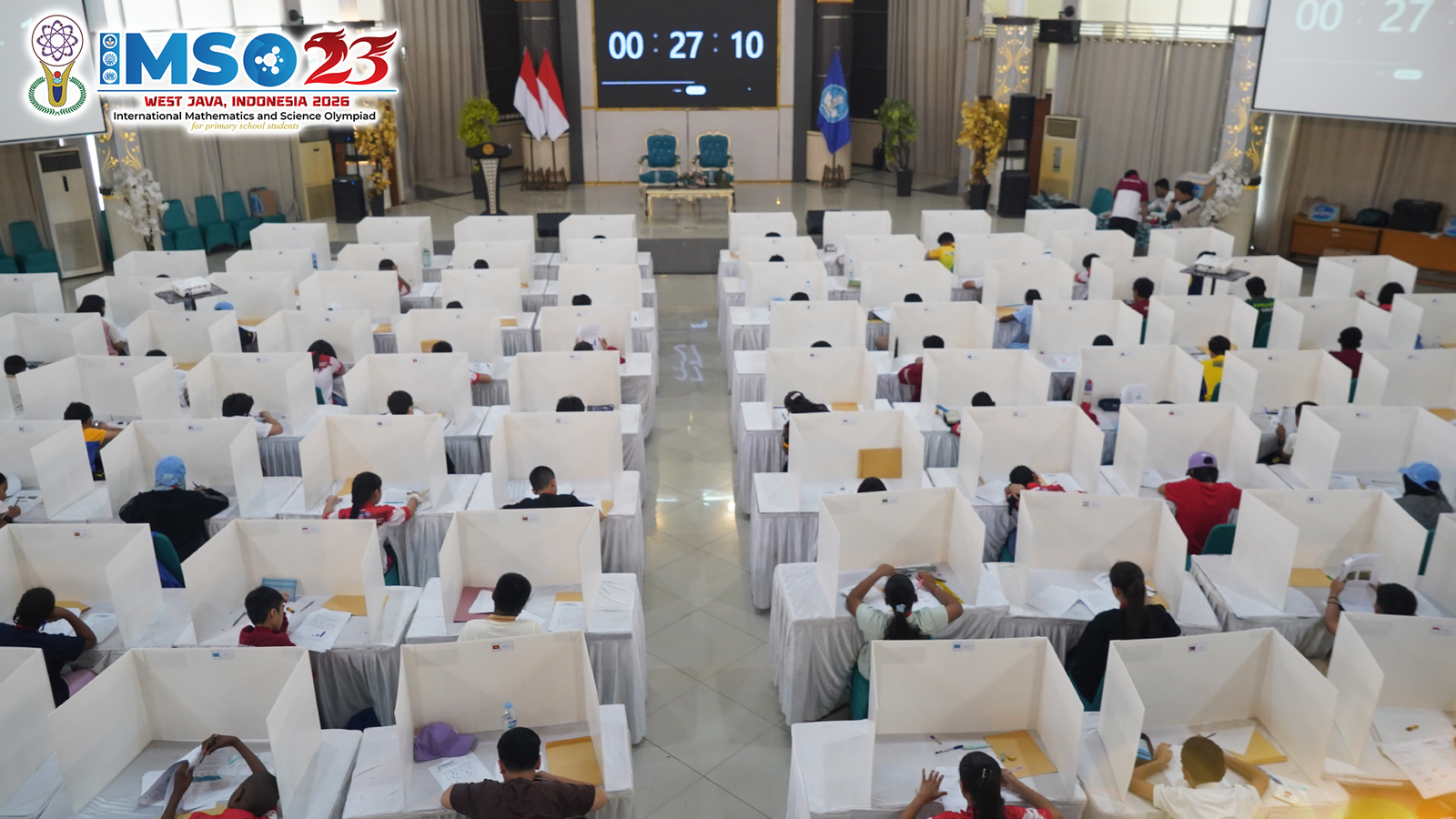
Depok, West Java — Following its official opening in Indonesia, the 23rd
International Mathematics and Science Olympiad (IMSO-23) entered its main
competition phase on October 4–5, 2026. Students from 23 countries are taking
on a variety of Mathematics and Science challenges designed to test their
conceptual understanding, reasoning skills, problem-solving abilities, and
application of knowledge through experimentation.
Over the two-day competition, participants take part in several stages,
including Theory I, Theory II, Mathematics Exploration, and Science
Experimentation. Each stage features different types of challenges to assess
the participants’ abilities more comprehensively.
In Mathematics, participants began the competition with Theory I,
consisting of 25 short-answer questions to be completed within 60 minutes. They
then proceeded to Theory II, which consists of 13 open-ended questions with a
90-minute time limit.
Beyond their ability to solve mathematical problems, participants also
take part in the 120-minute Mathematics Exploration. The multi-step problems in
this session require participants to apply logical thinking, conduct analysis,
develop solution strategies, and demonstrate Higher Order Thinking Skills
(HOTS).
Meanwhile, the Science competition began with Theory I, consisting of 30
multiple-choice questions to be completed within 60 minutes. In Theory II,
participants worked on nine multi-step open-ended questions within 90 minutes.
Their ability to apply knowledge directly was then tested through the
120-minute Science Experimentation session. Participants faced two experiments
that required them to understand scientific concepts, conduct practical
investigations, and develop solutions using the tools and materials provided
according to the instructions.
For the Indonesian delegates, IMSO-23 is an opportunity to demonstrate
the abilities they have developed through a series of selection processes,
training programs, and centralized preparation. The Indonesian team is aiming
for the best possible results, including Gold, Silver, and Bronze Medals.
However, the final achievements will depend on the competition results and the
strong performance of talented students from 23 countries. The students are
expected to give their best, compete to the fullest, and gain valuable
experience through an international Mathematics and Science competition.
In addition to serving as a competition, IMSO-23 also provides academic
opportunities for outstanding participants. Gold and Silver Medalists have the
opportunity to receive scholarships at NUS Junior High School in Singapore. This opportunity serves as a form of recognition for their achievements while
opening pathways for students to further pursue their education
internationally.
The IMSO-23 appreciation also includes the Best Theory, Best
Exploration/Experiment, and Best Overall awards. Best Theory is
determined based on participants’ theory test results, while Best
Exploration/Experiment is awarded based on performance in Mathematics
Exploration or Science Experimentation. Meanwhile, Best Overall is
determined based on the accumulated scores from all competition components.
After completing all competition stages, participants will continue with
the remaining IMSO-23 activities, culminating in the Awarding & Closing
Ceremony on October 6, 2026, which will mark the conclusion of IMSO-23.
Through a combination of theory tests, exploration, experimentation, and other international activities, IMSO-23 serves not only as a platform to assess academic abilities but also as an opportunity for students from different countries to develop critical thinking, creativity, reasoning, and problem-solving skills, while gaining valuable international experiences and building friendships across borders.